Peak15Adventure

Nuptse (7,861m) Expeditions

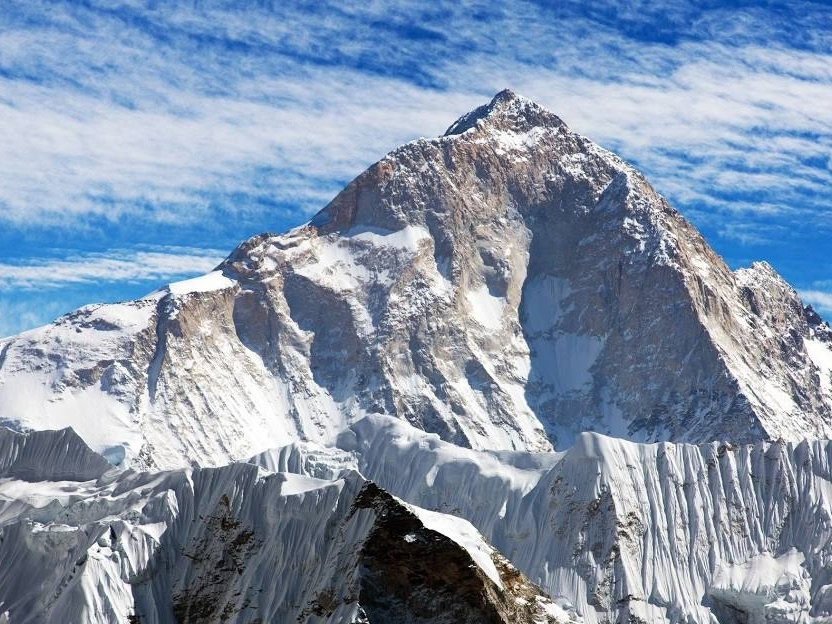
Nuptse (7,861m) Expedition is a demanding Himalayan mountaineering adventure into the heart of Nepal’s Everest region, where dramatic ridgelines, steep faces, and complex glaciated terrain define the climb. Rising beside Everest, Nuptse offers experienced climbers an opportunity to pursue a technical 7,000-meter summit in one of the world’s most iconic mountain environments. The expedition combines a classic approach through the Khumbu with strategic acclimatization, advanced climbing preparation, and a carefully managed summit campaign. From the approach beneath towering Himalayan giants to the final ascent toward Nuptse’s lofty summit, every stage demands endurance, precision, and sound judgment. With Peak 15 Adventure, the expedition is designed around professional logistics, experienced high-altitude support, and a safety-conscious approach to one of Nepal’s most compelling climbing challenges.

Duration
40 days
Max Altitude
7861 m
Destination
Nepal
Activity
Expedition
Accommodation
Teahouse
Group Size
2-6
Transport
Private Vehicle & Flight
Meals
B-L-D
Season
Apr - May
Difficulty
Advanced

Why travellers love it

  • Conquer Nuptse at 7,861m - Take on one of the Khumbu’s most striking high-altitude summits, surrounded by the legendary Everest mountain panorama.

  • Technical Himalayan Climbing - Navigate steep snow, ice, exposed terrain, and glaciated sections that demand strong mountaineering skills and careful movement.

  • Immersive Khumbu Approach - Trek through the iconic Sherpa landscapes, traditional mountain villages, monasteries, and dramatic valleys on the way toward the expedition base camp.

  • Strategic Acclimatization & Summit Preparation - Build altitude tolerance progressively through planned acclimatization, climbing practice, and carefully managed rotations before the summit push.

  • Professional Expedition Support - Benefit from coordinated logistics, experienced high-altitude Sherpa support, climbing equipment management, and a safety-focused summit strategy from Peak 15 Adventure.

Trip overview

Rising dramatically above the Khumbu Valley, Nuptse (7,861m) is a mountain of extraordinary character-steep, complex, and uncompromising. Its name, meaning “West Peak” in Tibetan, reflects its position on the western side of Everest, yet Nuptse has developed an identity of its own as a serious Himalayan climbing objective. With its imposing ridges, steep faces, hanging glaciers, and intricate high-altitude terrain, the mountain demands far more than physical endurance. It calls for technical competence, disciplined acclimatization, sound route judgment, and the ability to remain composed in an environment where conditions can change rapidly.

The Nuptse Expedition with Peak 15 Adventure begins with preparation in Kathmandu before following the legendary trail into the Everest region. The approach provides a gradual transition from the bustle of the capital to the immense mountain wilderness of the Khumbu. Passing through celebrated Sherpa settlements, Buddhist monasteries, suspension bridges, and high mountain valleys, climbers gradually gain altitude while becoming familiar with the environment that will eventually surround their expedition.

As the team moves deeper into the Khumbu, the landscape becomes increasingly dominated by Himalayan giants. The approach toward Nuptse Base Camp brings the expedition into a more remote and demanding setting, where glaciers, moraine, snowfields, and towering peaks replace the cultivated valleys below. Base camp becomes the operational heart of the expedition-a place for acclimatization, equipment preparation, route planning, weather monitoring, and developing the rhythm required for a prolonged high-altitude climb.

The climbing phase is where Nuptse reveals its true character. The ascent involves technical Himalayan terrain requiring efficient use of crampons, ice axes, ropes, fixed lines, and other mountaineering equipment. Planned acclimatization rotations help the team progressively adapt to decreasing oxygen levels while gaining familiarity with the route and higher camps. Rather than treating the summit as a single push, the expedition is structured around patience, preparation, and careful adaptation to the mountain.

Above the lower camps, the environment becomes increasingly austere. Steeper slopes, exposed sections, snow and ice formations, and the effects of extreme altitude demand concentration with every movement. The final summit attempt is therefore the culmination of weeks of preparation rather than simply the final day of the expedition. Weather, snow conditions, team health, route security, and acclimatization all influence the timing and strategy of the summit bid.

Reaching the 7,861m summit of Nuptse offers a remarkable perspective across the Everest region, with an immense panorama of the surrounding Himalayan peaks and the deep valleys far below. Yet the summit is only one part of the achievement. The journey back to base camp and eventually into the Khumbu Valley remains an essential component of a successful expedition, requiring the same discipline and attention to safety as the ascent.

At Peak 15 Adventure, we approach the Nuptse Expedition as a carefully coordinated high-altitude undertaking. From pre-expedition preparation and logistical planning to experienced climbing support, acclimatization strategy, equipment coordination, and mountain operations, each element is organized to support a demanding Himalayan objective. Nuptse is not simply another 7,000-meter mountain-it is a test of technical ability, endurance, patience, and judgment in one of Nepal’s most spectacular alpine environments.

Itinerary

  • Day 01

    Arrival in Kathmandu and Transfer to the Hotel (1,400m)

    Your Nuptse Expedition begins with your arrival in Kathmandu (1,400m), the vibrant gateway to Nepal’s high Himalayas. Upon landing, a representative from Peak 15 Adventure will welcome you at the airport and arrange a comfortable transfer to your hotel. After check-in, you can rest and recover from your journey or take some time to experience the lively atmosphere of Kathmandu.

    This first day is intentionally kept relaxed, allowing you to settle in, adjust to the local environment, and prepare mentally for the demanding expedition ahead. Depending on your arrival time, our expedition team will provide initial information about the upcoming program and assist with any immediate requirements.

    • MealsB
    • AccommodationHotel
    • Travel Duration30-45 min
    • RouteKathmandu International Airport to Kathmandu
    • TransportationPrivate Vehicle
    • Elevation1,400m to 1,400m
  • Day 02

    Expedition Briefing, Official Formalities, Gear Check & Shopping (1,400m)

    Today is dedicated to preparing for the technical challenges of the Nuptse (7,861m) Expedition. After breakfast, you will meet the Peak 15 Adventure expedition team for a comprehensive briefing covering the climbing itinerary, route strategy, acclimatization plan, safety protocols, and logistics for the journey into the Khumbu region.

    Our team will assist with the necessary expedition formalities, permit documentation, and final administrative arrangements. A detailed equipment inspection follows, allowing our climbing specialists to check your personal mountaineering gear, clothing, boots, and technical equipment for suitability in Nuptse's demanding high-altitude environment.

    If any essential items are missing, you will have time to visit specialized mountaineering shops in Kathmandu to purchase or rent the required equipment. The day also provides an opportunity to discuss individual concerns, review emergency procedures, and finalize preparations before leaving the capital for the mountains.

    • MealsB/L/D
    • AccommodationHotel
    • RouteKathmandu to Kathmandu
    • Elevation1,400m to 1,400m
  • Day 04

    Fly to Lukla (2,860m) & Trek to Phakding (2,610m)

    After an early breakfast, we transfer to the airport for a scenic mountain flight to Lukla (2,860m), the gateway to the Everest region. The short flight offers spectacular views of Nepal's Himalayan landscapes, with snow-covered peaks and rugged mountain valleys unfolding beneath you. Upon arrival, you will meet the local trekking crew, organize your expedition baggage, and begin the first trekking stage toward Nuptse.

    The trail descends gradually from Lukla through charming Sherpa settlements, stone-paved paths, and small farming communities. Following the Dudh Koshi River, we cross suspension bridges decorated with prayer flags and pass through beautiful pine forests and traditional villages. The route takes us through Chheplung, Thadokoshi, and Ghat before reaching Phakding (2,610m).

    Although today's trek is relatively short, it provides an excellent opportunity to ease into the expedition rhythm, enjoy the surroundings, and begin adapting to the Himalayan environment. After reaching Phakding, we settle into a local teahouse and prepare for the journey deeper into the Khumbu Valley.

    • MealsB/L/D
    • AccommodationTeahouse
    • Travel Duration30-40 min & 3-4 hours
    • RouteLukla to Phakding
    • TransportationFlight & Trekking
    • Elevation2,860m to 2,610m
  • Day 05

    Trek to Namche Bazaar (3,440m)

    After breakfast in Phakding, we continue our journey toward Namche Bazaar (3,440m), the vibrant Sherpa capital and a major gateway to the Everest region. Today's trek follows the Dudh Koshi River through beautiful pine forests, traditional villages, and dramatic Himalayan landscapes, gradually gaining elevation as we move deeper into the Khumbu.

    The trail passes through Toktok, Benkar, and Monjo, where we enter Sagarmatha National Park after completing the necessary permit formalities. Beyond Jorsalle, the route follows the river before crossing the iconic Hillary Suspension Bridge, which hangs high above the confluence of mountain streams. From here, the trail climbs steadily through forested hillsides, offering the first impressive views of Everest and neighboring Himalayan peaks when weather conditions permit.

    The final ascent to Namche Bazaar is demanding, with a sustained uphill climb that provides an important introduction to trekking at increasing elevations. Upon arrival, we settle into our teahouse and enjoy the lively atmosphere of this picturesque mountain town, surrounded by towering peaks and traditional Sherpa architecture.

    Namche is an important acclimatization point for the Nuptse expedition, allowing the team to rest, monitor individual adaptation, and prepare for the higher elevations ahead.

    • MealsB/L/D
    • AccommodationTeahouse
    • Travel Duration6-7 hours
    • RoutePhakding to Namche Bazaar
    • TransportationTrekking
    • Elevation2,610m to 3,440m
  • Day 06

    Acclimatization Day in Namche Bazaar (3,440m)

    Today is an important acclimatization day in Namche Bazaar (3,440m), allowing your body to adapt to the increasing altitude before continuing toward the higher elevations of the Nuptse (7,861m) Expedition. Proper acclimatization is essential for high-altitude mountaineering, helping reduce the risk of altitude-related illness and preparing climbers for the demanding days ahead.

    After breakfast, we follow the principle of “climb high, sleep low” with a gradual acclimatization hike above Namche Bazaar. Depending on weather conditions and the team's overall fitness, we may hike toward the Everest View Hotel (approximately 3,880m), offering spectacular views of Mount Everest, Lhotse, Ama Dablam, and the surrounding Himalayan peaks. The walk provides a valuable opportunity to gain elevation gradually while enjoying the extraordinary scenery of the Khumbu region.

    After returning to Namche, the remainder of the day is available for rest, hydration, and personal exploration. You may visit the Sherpa Museum, explore local markets, or enjoy the cafés and bakeries that make Namche a memorable mountain stop. Our expedition team will also monitor everyone's health and discuss the upcoming trekking stages.

    This acclimatization day is not simply a break in the itinerary; it is an essential part of preparing for the technical and physical challenges of Nuptse.

    • MealsB/L/D
    • AccommodationTeahouse
    • RouteNamche Bazaar to Namche Bazaar
    • Transportationacclimatization hike toward Everest View Hotel
    • Elevation3,440m to 3,440m
  • Day 07

    Trek to Tengboche (3,860m)

    After breakfast in Namche Bazaar, we continue our journey toward Tengboche (3,860m), following one of the most scenic sections of the Everest region. Today's trail traverses the hillside above the Dudh Koshi Valley, offering magnificent views of Everest, Lhotse, Nuptse, and the distinctive pyramid of Ama Dablam. As we leave Namche behind, the path winds through beautiful forests, traditional Sherpa settlements, and peaceful mountain landscapes.

    We begin with a gradual ascent toward Kyangjuma before following a relatively gentle trail to Sanasa. From here, the route descends through forested slopes to Phunki Tenga, a small riverside settlement where we stop for lunch and a short rest. Crossing the Dudh Koshi River, we begin the sustained uphill climb through pine and rhododendron forests toward Tengboche.

    The final ascent requires steady effort as the altitude increases, but the surrounding Himalayan scenery makes every step rewarding. Upon reaching Tengboche, we visit the renowned Tengboche Monastery, one of the most significant Buddhist spiritual centers in the Khumbu region, subject to its opening schedule and local practices.

    With Nuptse and its neighboring Himalayan giants rising dramatically above the valley, Tengboche offers an inspiring setting to reflect on the expedition ahead. We settle into our teahouse, enjoy dinner, and rest for the next stage of the journey.

    • MealsB/L/D
    • AccommodationTeahouse
    • Travel Duration5-6 hours
    • RouteNamche Bazaar to Tengboche
    • TransportationTrekking
    • Elevation3,440m to 3,860m
  • Day 08

    Trek to Dingboche (4,410m)

    After breakfast, we leave Tengboche and continue deeper into the Khumbu Valley toward Dingboche (4,410m), an important high-altitude settlement and acclimatization point for the Nuptse expedition. The trail initially descends through beautiful rhododendron and conifer forests toward Deboche before crossing the rushing Imja Khola. As the landscape opens up, the vegetation gradually becomes sparser and the immense Himalayan peaks begin to dominate the horizon.

    From Deboche, the trail continues toward Pangboche, one of the oldest permanent settlements in the region. Along the way, we are surrounded by spectacular views of Ama Dablam, Lhotse, Island Peak, and the rugged mountain walls of the Khumbu. The route then follows the Imja Valley, gradually climbing through increasingly arid alpine terrain toward Dingboche.

    The final section involves a steady ascent, and the thinner air becomes increasingly noticeable as we gain elevation. Upon reaching Dingboche, we settle into our teahouse and allow the body to recover. This high-altitude village will become an important staging point for further acclimatization before we move toward Everest Base Camp and eventually Nuptse Base Camp.

    • MealsB/L/D
    • AccommodationTeahouse
    • Travel Duration5-6 hours
    • RouteTengboche to Dingboche
    • TransportationTrekking
    • Elevation3,860m to 4,410m
  • Day 09

    Rest & Acclimatization Day in Dingboche (4,410m)

    Today is dedicated to rest and acclimatization in Dingboche (4,410m), an essential pause before progressing toward the higher elevations of the Everest region. Rather than remaining completely inactive, the day is designed around light movement, hydration, recovery, and allowing the body to adapt naturally to the thinner air.

    After breakfast, we take a gradual acclimatization hike above Dingboche. Depending on weather, trail conditions, and the group's condition, we may climb toward the surrounding ridges for broader views of Lhotse, Nuptse, Ama Dablam, Island Peak, and the Imja Valley. The ascent provides valuable exposure to a higher elevation while allowing the team to return to Dingboche to sleep at a lower altitude.

    The remainder of the day is reserved for rest and preparation. Our expedition leaders will monitor the team's health, discuss the effects of altitude, and review the upcoming stages of the journey. Climbers can also organize personal equipment, replenish water, enjoy nutritious meals, and mentally prepare for the increasingly demanding terrain ahead.

    A successful high-altitude expedition is built through patience. This acclimatization day gives the body time to adjust before the team continues toward the higher valleys and eventually the Nuptse climbing environment.

    • MealsB/L/D
    • AccommodationTeahouse
    • RouteDingboche to Dingboche
    • Transportationacclimatization hike to a higher nearby viewpoint
    • Elevation4,410m to 4,410m
  • Day 10

    Trek to Lobuche Village (4,910m)

    After breakfast, we leave Dingboche (4,410m) and continue toward Lobuche Village (4,910m), entering a more rugged and distinctly alpine section of the Khumbu. The trail gradually climbs through the broad valley toward Duglha, with the landscape becoming increasingly barren as trees disappear and rocky Himalayan terrain takes over.

    From Duglha, the route rises more steeply toward the terminal moraine of the Khumbu Glacier. Along the trail, memorials dedicated to climbers and mountaineers who lost their lives in the Himalayas offer a quiet reminder of the seriousness of the high-altitude environment. We continue steadily toward the Lobuche Valley, surrounded by dramatic peaks and glacial landscapes.

    As we approach Lobuche, the presence of Nuptse, Pumori, and the surrounding Everest-region giants becomes increasingly imposing. The higher elevation makes the trek more demanding, so maintaining a slow, consistent pace is important. After reaching Lobuche, we settle into our accommodation, hydrate, and rest while the expedition team reviews the next stage of the journey.

    Today's trek marks another significant step toward the higher mountain environment. With each kilometer, the landscape becomes more remote, the air thinner, and the objective of Nuptse increasingly tangible.

    • MealsB/L/D
    • AccommodationTeahouse
    • Travel Duration5-6 hours
    • RouteDingboche to Lobuche Village
    • TransportationTrekking
    • Elevation4,410m to 4,910m
  • Day 11

    Trek to Nuptse Base Camp (5,364m)

    After an early breakfast, we leave Lobuche Village and begin the demanding approach toward the high-altitude climbing environment of Nuptse. The trail leads deeper into the glacial landscape of the Khumbu, with the surrounding terrain becoming increasingly rugged, rocky, and exposed as we gain elevation.

    Today’s route brings us toward the Everest Base Camp area (5,364m), from where the expedition transitions from trekking to a more focused mountaineering phase. The trail follows the Khumbu Glacier and its surrounding moraine, requiring careful footing on uneven rocky terrain. Towering Himalayan peaks rise around us, creating an extraordinary alpine setting as we move farther from the lower valleys.

    The effects of altitude become more pronounced today, so we maintain a deliberate pace with regular breaks for hydration and recovery. Upon reaching the high-altitude camp area, the expedition team will organize equipment, review the upcoming climbing program, and ensure that everyone is prepared for the transition toward the Nuptse climbing period.

    Standing among the glaciers and immense peaks of the upper Khumbu, the scale of the expedition becomes unmistakable. From this point onward, every stage requires greater attention to acclimatization, weather, route conditions, and personal well-being.

    • MealsB/L/D
    • AccommodationTeahouse
    • Travel Duration6-7 hours
    • RouteLobuche Village to Everest Base Camp area
    • TransportationTrekking
    • Elevation4,910m to 5,364m
  • Day 12

    Prayer Ceremony, Technical Training & Acclimatization at Nuptse Base Camp (5,364m)

    Days 12 to 15 are dedicated to spiritual preparation, technical climbing training, and acclimatization at the high-altitude base camp area. Before beginning the serious climbing phase, the team takes time to establish a strong foundation for the ascent, allowing climbers to adapt further to the altitude while becoming familiar with the equipment, techniques, and discipline required for Nuptse.

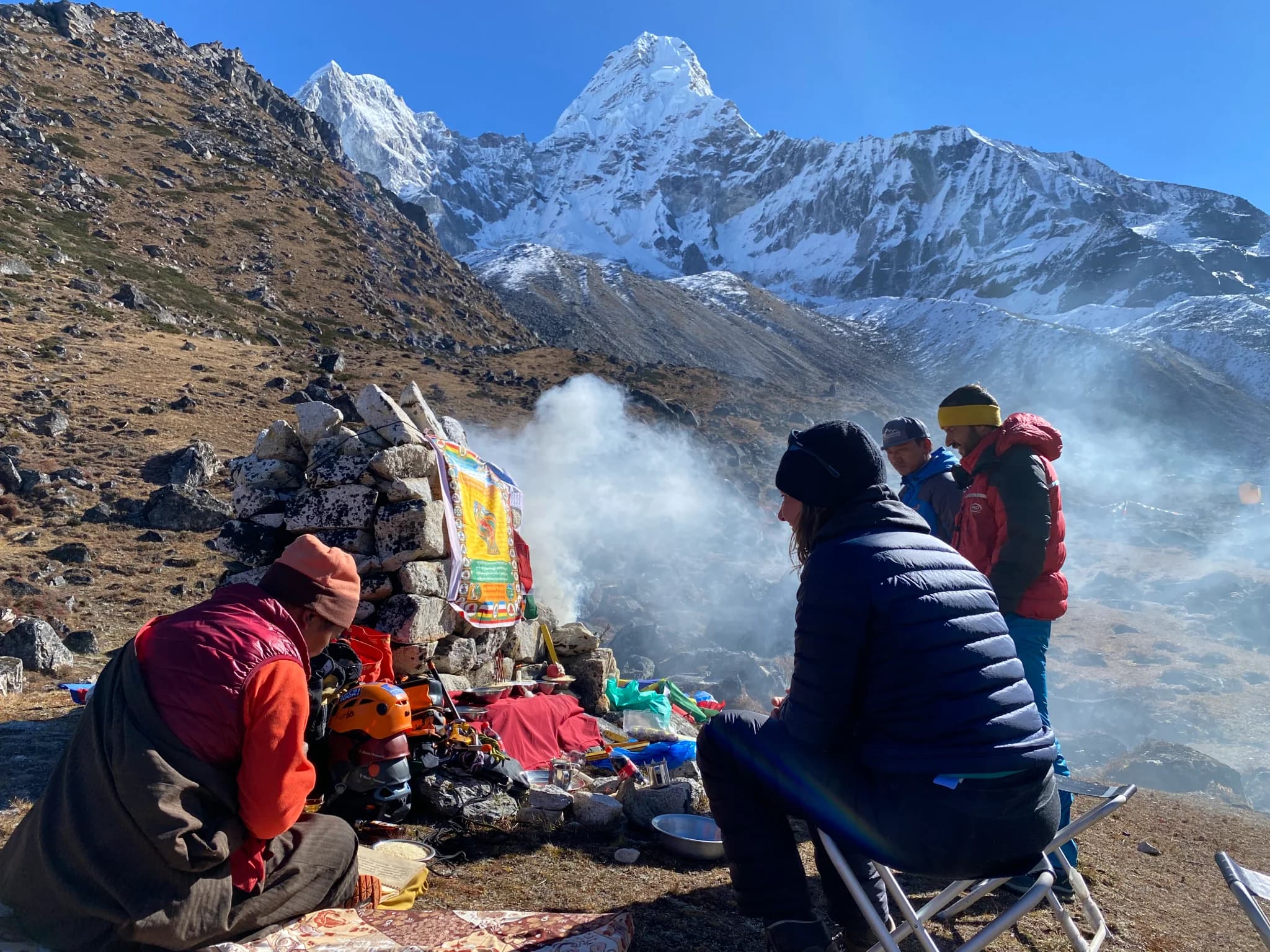
    The period begins with a traditional puja prayer ceremony, an important Himalayan mountaineering ritual performed to seek blessings and safe passage from the mountain. Climbers, Sherpa guides, and expedition staff gather for the ceremony, offering prayers and paying respect to the sacred mountain environment before entering the more demanding climbing terrain.

    Following the ceremony, the expedition team conducts practical training sessions covering essential high-altitude climbing techniques. Depending on route conditions, training may include crampon movement, ice-axe techniques, fixed-rope ascents and descents, harness and carabiner use, ascender and descender systems, rope management, glacier travel, and safe movement on snow and ice. These sessions provide an opportunity to refresh important skills and ensure that every climber is comfortable with their equipment before moving higher.

    The remaining time is structured around progressive acclimatization and recovery. Short hikes around the base camp and nearby terrain may be arranged to provide controlled exposure to higher elevations, while adequate rest is maintained between activities. The climbing team monitors individual adaptation, hydration, nutrition, sleep, and overall readiness throughout this period.

    These four days also allow the expedition team to organize loads, inspect technical equipment, review weather information, discuss the climbing route, and refine the upcoming acclimatization rotations. Flexibility is maintained because the exact training and acclimatization schedule may change according to weather, route conditions, and the team's physical condition.

    By the end of this preparation period, climbers should have a clearer understanding of the technical demands ahead and be better adapted to the high-altitude environment. The mountain phase now moves from preparation toward execution, with the team ready to begin its carefully managed ascent of Nuptse.

    • MealsB/L/D
    • AccommodationTented camp
    • Travel Duration4 days
    • RouteNuptse Base Camp area to Nuptse Base Camp
    • Transportationacclimatization, technical training, preparation, and rest
    • Elevation5,364m to 5,364m
  • Day 16

    Climb to Camp I (6,065m)

    Today marks the beginning of the serious climbing phase of the Nuptse (7,861m) Expedition as we leave Base Camp and ascend toward Camp I (6,065m). After an early breakfast and final equipment check, the team begins climbing through the glaciated terrain above Base Camp, carrying only the equipment required for the rotation.

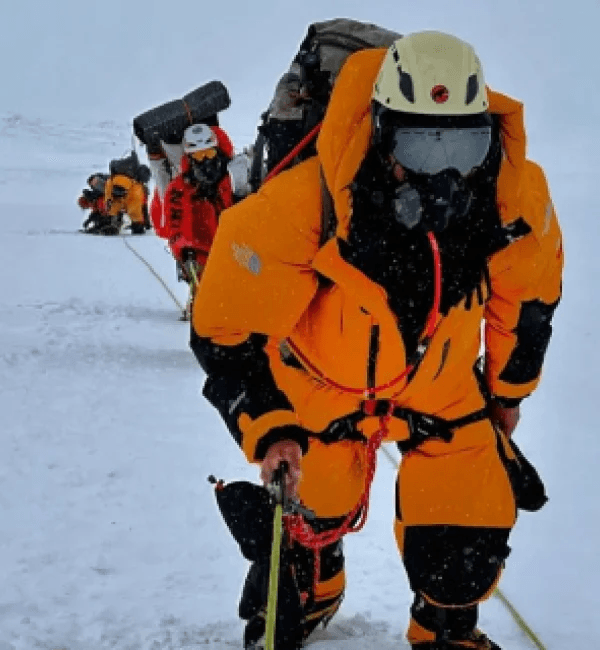
    The ascent demands careful movement as the route transitions from rocky moraine to snow and ice. Climbers use crampons and technical equipment as required by the prevailing route conditions, while the climbing Sherpa team manages fixed ropes and assists with safe movement through more challenging sections. The pace remains deliberately controlled, allowing the body to adapt to the increasing altitude without unnecessary exertion.

    As we gain elevation, the surrounding panorama becomes increasingly dramatic, with the immense walls and glaciers of the Everest region stretching across the horizon. The thinner air at 6,000m makes even familiar movements more demanding, so regular hydration, short breaks, and efficient pacing are essential.

    After reaching Camp I, the team settles into the high-altitude camp, organizes equipment, and prepares for the next stage of the acclimatization rotation. The evening is focused on rest, hydration, nutrition, and monitoring each climber's response to the increased elevation.

    Today's ascent is more than simply gaining altitude—it is the first major step into the high-altitude world where Nuptse's technical character begins to fully reveal itself.

    • MealsB/L/D
    • AccommodationTented Camp
    • Travel Duration5-7 hours
    • RouteNuptse Base Camp to Camp I
    • TransportationClimbing
    • Elevation5,364m to 6,065m
  • Day 17

    Climb from Camp I to Camp II (6,400m)

    Leaving Camp I (6,065m) after an early breakfast, we continue our ascent toward Camp II (6,400m), moving deeper into Nuptse's high-altitude climbing terrain. The increasing elevation makes the air noticeably thinner, and the team maintains a slow, deliberate rhythm to conserve energy and support continued acclimatization.

    The route progresses across steep snow and glaciated terrain, with the exact climbing conditions depending on the season and current route. Fixed ropes may be used on steeper sections, requiring efficient handling of the ascender, harness, carabiners, and other technical equipment. Our climbing Sherpa team provides guidance and support while climbers maintain appropriate spacing and disciplined rope technique.

    At this elevation, every movement requires greater concentration. The team takes regular breaks for hydration and recovery while carefully monitoring weather, snow conditions, and individual responses to altitude. Reaching Camp II represents another important stage in the acclimatization process and brings us closer to the upper mountain.

    After arriving at Camp II (6,400m), we organize our equipment, settle into the tents, and focus on hydration, nutrition, and rest. The expedition leader and climbing team review conditions and discuss the next rotation based on weather, route security, and team readiness.

    • MealsB/L/D
    • AccommodationTented Camp
    • Travel Duration4-6 hours
    • RouteCamp I to Camp II
    • TransportationClimbing
    • Elevation6,065m to 6,400m
  • Day 18

    Rest & Acclimatization at Camp II (6,400m)

    Today is dedicated to rest and acclimatization at Camp II (6,400m), giving the body valuable time to adapt to the extreme altitude before the expedition progresses toward the upper mountain. At this elevation, reduced oxygen makes even simple movements considerably more demanding, so conserving energy and allowing adequate recovery are essential.

    The day begins with a nutritious breakfast and a careful health check by the expedition team. Depending on weather, route conditions, and the team's physical condition, a short acclimatization activity may be arranged around camp or on nearby terrain. The purpose is controlled exposure to altitude rather than strenuous exercise.

    Much of the day is reserved for hydration, nutrition, rest, and equipment preparation. Climbers can inspect their technical gear, organize personal equipment, and prepare clothing and supplies required for the next climbing rotation. The expedition leader and climbing Sherpa team will also monitor weather forecasts and route conditions while reviewing the upcoming ascent.

    This rest day plays an important role in building the physical readiness required for the higher sections of Nuptse. Patience at this altitude is part of the climb; allowing the body to recover today can be as important as gaining elevation tomorrow.

    • MealsB/L/D
    • AccommodationTented Camp
    • RouteCamp II to Camp II
    • Transportationacclimatization, equipment preparation, and team assessment
    • Elevation6,400m to 6,400m
  • Day 19

    Descend from Camp II to Nuptse Base Camp (5,364m)

    After spending valuable time acclimatizing at Camp II (6,400m), we begin our descent toward Nuptse Base Camp (5,364m). Descending to a lower elevation allows the body to recover from the demands of the high camps while consolidating the acclimatization gained during the previous climbing rotation.

    We make our way carefully down the established route, using fixed ropes and technical equipment where required. The descent across steep snow, ice, and glaciated terrain demands just as much concentration as the ascent, particularly when climbers are tired from time spent at high altitude. The climbing Sherpa team provides guidance through technical sections and helps maintain safe movement throughout the descent.

    As we lose elevation, the air gradually becomes richer in oxygen, making breathing and recovery easier. Upon reaching Base Camp, the team settles back into a more comfortable environment and focuses on hydration, nutritious meals, rest, and recovery.

    The remainder of the day provides an opportunity to reorganize equipment, review the progress of the acclimatization rotation, and prepare for the next phase of the expedition. The climbing team will assess weather and route conditions and determine the appropriate timing for the next ascent.

    • MealsB/L/D
    • AccommodationTented Camp
    • Travel Duration4-6 hours
    • RouteCamp II to Nuptse Base Camp
    • TransportationDecending
    • Elevation6,400m to 5,364m
  • Day 20

    Descends To Namche Bazar Or Fly To Kathmandu For Good Rest (All The Expenses Like Hotel Stay, Meals, Helicopter Etc. Are Not Included).

    Descends to Namche Bazar or fly to Kathmandu for good rest (All the expenses like hotel stay, meals, helicopter etc. are not included).

  • Day 26

    Back To Base Camp, Analyze Weather Conditions & Prepare For The Final Summit Push.

    Back To Base Camp, Analyze Weather Conditions & Prepare For The Final Summit Push.

  • Day 28

    Climb To Camp II (6,400 M) & Rest Day.

    Climb To Camp II (6,400 M) & Rest Day.

  • Day 30

    Climb To Nuptse Camp III (7,300 M).

    Climb to Nuptse Camp III (7,300 m).

  • Day 31

    Summit Nuptse (7,861 M) & Descend To Camp II.

    Summit Nuptse (7,861 M) & Descend To Camp II.

  • Day 32

    Descend To Base Camp.

    Descend To Base Camp.

  • Day 33

    Clean Up Base Camp.

    Clean Up Base Camp.

  • Day 34

    Trek Down To Pheriche.

    Trek Down To Pheriche.

  • Day 35

    Trek Down To Namche Bazar.

    The trek on this day includes trekking downhill until we reach Deboche. Then we will climb uphill towards Tengboche before descending toward Phungi Tenga. We will then again climb uphill to Kyangjuma and later walk on a smooth trail until we reach Namche Bazaar.

  • Day 36

    Trek Down To Lukla.

    This will be the last day of our trek on the Nuptse Expedition Journey. We start early from Namche Bazaar and walk past the forests of Rhododendron, Oak, and Pine Trees. The trail is easy and less tiring as most of the walk is within the forests. We take some short uphill climbs, cross the suspension bridges and pass the village of Monjo. After an uphill climb of about 45 minutes, we finally reach Lukla.

  • Day 37

    Fly From Lukla To Kathmandu.

    On the 39th day of our journey, we will take the short flight back to Kathmandu collecting and preserving our memories of the Himalayas. In Kathmandu, you can relax in Thamel, a popular street for tourists where you can get anything you want. You may do some shopping, eat in a nice restaurant, get some spa, do some laundry and many other things. There are also many different attractions in Kathmandu including but not limited to Swayambhunath, Pashupatinath, Bouddhanath Stupa, Basantapur, Bhaktapur, Patan, and so on. You may go sightseeing around these areas with one of our city guides. We will join for the farewell dinner in the evening.

  • Day 38

    Departure To Home.

    Our journey of Trek to Everest Base Camp ends on this day. With so many beautiful memories together, we gratefully and delightedly bid you farewell and good luck for your flight back home. One of our representatives from 8K expeditions will drop you off at TIA 3 hours prior to your scheduled flight

  • Day 39

    Contingency Days.

    Contingency Days.

Altitude profileMax 7,861 m
1,400 mD11,400 mD22,610 mD43,440 mD53,440 mD63,860 mD74,410 mD84,410 mD94,910 mD105,364 mD115,364 mD126,065 mD166,400 mD176,400 mD185,364 mD195,364 mD205,364 mD266,400 mD287,300 mD307,861 mD317,861 mD327,861 mD337,861 mD347,861 mD357,861 mD367,861 mD377,861 mD387,861 mD39

Are you looking to customize the trip itinerary?

If the provided schedule is not suitable for you, we can create a personalized travel arrangement tailored to your preferences and requirements.

Customize Trip

Cost breakdown

What's included
  • Pick up and drop off services for both international & domestic flights as per the itinerary.

  • 4 nights 4* Hotel in Kathmandu on Bed & Breakfast plan, 2 nights before and 2 nights after the expedition.

  • Welcome dinner in a typical Nepali Restaurant in Kathmandu.

  • Both-ways domestic flight via Ramechhap (Ktm – Lukla – Ktm) with airport tax. Early morning 5 hrs. drive from Kathmandu to Ramechap and further domestic flight to Lukla.

  • Land and Air domestic transportation and cargo for overall expedition.

  • Climbing Permit for Nuptse (7,861m) Expedition and other necessary permit fees.

  • Nepalese Government Liaison officer with his daily wages, equipment allowance, food, insurance and transportation.

  • Summit route fixing charge for Nuptse (7,861m) Expeditions.

  • Garbage disposal and management fees.

  • Insurance of Nepalese staffs of High Altitude, Medical and emergency Helicopter rescue (in group)

  • Base Camp Cook and Kitchen helpers and all kitchen utensils for cooking at BC.

  • 3 Meals a day (BLD) during the trekking from Lukla to Base Camp to Lukla.

  • High food for high camps with cooking burners and tents to sleeping

  • Freshly cooked meals (Breakfast, Lunch & Dinner): Continental, Nepali, Indian with hot drinks, Tea and Coffee.

  • 01 veteran and highly experienced Climbing Guide (01 Member: 01 Climbing Guide)

  • 45 kg as a member personal baggage.

  • Each member will be provided an individual tent, Mattress and Pillow at Base Camp

  • Common Equipment at Base Camp: Dinning tent, Kitchen tent, Toilet tent, Shower tent, Tables and Chairs, Heater etc.

  • Walkie-talkie for communicating from Base Camp to Mountain and Mountain to Base Camp.

  • Satellite Phone is available for emergency call at US $5 per minute.

  • Weather forecast during the entire expedition.

  • Emergency Oxygen bottles and Mask Regulator Set available at our Base Camp (Chargeable as per use).

  • First Aid medical kit (carried by Guide)

  • Peak 15 Adventure’s Duffle Bag Outdoor Cap (If required).

  • Farewell dinner with Climbing guides, Office staffs and Company Owners in Kathmandu after the expedition.

  • Government taxes and company service charge.

  • Summit Certificate will be provided by Nepal Government after the successful ascent of the peak (Note: Photos & videos of summit must be provided for final verification).

What's not included
  • International flights to/from Kathmandu.

  • Nepal Entry Visa fee (to be applied for 40 days).

  • Drone and Special filming permit.

  • Meals in Kathmandu not specified in the package.

  • Travel, Medical and Emergency High Altitude Helicopter Rescue Insurance (Minimum coverage US$ 50,000). This is mandatory for all the Participants. Emergency rescue costs beyond insurance All the Personal Climbing Gears and Equipment.

  • Costs from delays due to weather or itinerary changes.

  • Summit Bonus US$ 800/- for each Climbing Guide and US$ 250/- for Kitchen helpers must be hand over in Cash at Base Camp after the successful ascent of the peak also please calculate some tips for trek Guide and Porters.

  • Personal expenses (tips, laundry, drinks).

  • Any other services which are not mentioned in the service includes.

Upcoming departures

Filter departures by month
Mar 3 – Apr 12, 2027
Available
—

All prices per person, twin share. Subject to availability — Nuptse (7,861m) Expeditions dates fill quickly in peak season.

Useful information

Nuptse (7,861m) is a serious Himalayan expedition in the Everest region, combining a demanding approach through the Khumbu with technical climbing in a high-altitude environment. Its steep faces, exposed ridges, glaciated terrain, changing snow conditions, and extreme elevation require more than physical strength. Climbers should arrive with appropriate mountaineering experience, strong preparation, realistic expectations, and a disciplined approach to acclimatization and safety. Before entering the mountain environment, Peak 15 Adventure provides a detailed pre-trip briefing covering the expedition itinerary, climbing strategy, equipment, acclimatization, weather, safety procedures, and responsibilities of every expedition member.

Altitude & Acclimatization

  • The expedition reaches 7,861m, where reduced oxygen can significantly affect physical performance, recovery, concentration, and decision-making.

  • A carefully structured acclimatization schedule is essential before attempting the higher sections of Nuptse.

  • Climbers should ascend progressively and allow their bodies adequate time to adapt to increasing elevation.

  • Acclimatization rotations between Base Camp and higher elevations may be incorporated depending on the climbing plan, route conditions, weather, and individual adaptation.

  • Adequate hydration, nutritious meals, sufficient rest, and a controlled pace are essential throughout the expedition.

  • Symptoms such as persistent headache, dizziness, nausea, unusual fatigue, confusion, or difficulty breathing should be reported immediately to the expedition leader or climbing team.

  • Climbers should understand that acclimatization is individual; no fixed schedule can guarantee successful adaptation to extreme altitude.

Technical Climbing & Experience

  • Nuptse is a technical high-altitude mountaineering expedition, rather than a conventional trekking or straightforward peak-climbing journey.

  • Depending on the selected route and prevailing conditions, climbing may involve steep snow and ice, glaciers, exposed sections, fixed ropes, and technically demanding terrain.

  • Climbers should be proficient in the use of essential equipment such as crampons, ice axe, harness, helmet, ascender, descender, carabiners, and climbing slings.

  • Previous experience with high-altitude mountaineering, glacier travel, fixed-rope systems, and movement on snow and ice is strongly recommended.

  • Climbers should be physically capable of moving efficiently on steep terrain while carrying essential personal climbing equipment.

  • Rope techniques, crampon movement, ice-axe use, ascending and descending fixed lines, and safe movement on technical terrain should be familiar skills.

  • All climbers must follow the instructions of the expedition leader, climbing guides, and Sherpa team, particularly on exposed or technically complex sections.

Packing & Expedition Equipment

  • Bring properly fitted high-altitude mountaineering boots appropriate for prolonged exposure to cold, snow, and technical terrain.

  • Essential climbing equipment may include crampons, ice axe, climbing harness, helmet, ascender, descender, carabiners, slings, and other technical equipment specified by the expedition team.

  • A dependable layering system is essential, including thermal base layers, insulating mid-layers, a waterproof and windproof shell, and a suitable high-altitude down jacket.

  • Warm gloves, mittens, balaclava, thermal socks, and appropriate headwear are important for protection against severe cold and wind.

  • High-quality mountaineering sunglasses and goggles are essential because intense sunlight and snow glare can be particularly strong at altitude.

  • Carry a reliable headlamp with spare batteries for early-morning starts, movement around camps, and summit-day operations.

  • A suitable high-altitude sleeping bag, personal first-aid supplies, sunscreen, lip balm, water bottles, and personal medications should be included.

  • Peak 15 Adventure will provide a detailed equipment checklist before departure and advise which technical items can be rented or arranged in Nepal.

Weather & Mountain Conditions

  • Weather on Nuptse can change rapidly, particularly as the expedition moves above Base Camp.

  • Strong winds, snowfall, freezing temperatures, cloud, poor visibility, and changing snow or ice conditions can affect climbing operations.

  • Mountain conditions may influence the route, acclimatization rotations, camp schedule, and timing of the summit attempt.

  • The summit window depends heavily on a combination of suitable weather, route security, snow and ice conditions, and team readiness.

  • Even during the preferred climbing season, favorable conditions cannot be guaranteed.

  • Summit rotations may be delayed, modified, or cancelled when conditions become unsafe.

  • Flexibility is essential because the mountain ultimately determines the timetable.

Physical Fitness & Mental Preparation

  • Nuptse demands a high level of physical endurance, technical ability, and mental resilience.

  • Preparation should begin well before the expedition with cardiovascular conditioning, strength training, endurance work, and regular hiking or mountaineering.

  • Long-distance hikes with elevation gain and training with a loaded backpack can help prepare the body for prolonged days in the mountains.

  • Climbers should develop strength and endurance in the legs, core, and upper body while maintaining overall cardiovascular fitness.

  • Technical climbing practice on snow and ice should be incorporated into preparation whenever possible.

  • Climbers should be prepared for cold temperatures, reduced oxygen, long climbing days, basic facilities, and periods of physical and mental fatigue.

  • Mental preparation is equally important when facing changing weather, route adjustments, waiting periods, and the uncertainty inherent in high-altitude mountaineering.

  • Arrive prepared to be patient, disciplined, adaptable, and respectful of decisions made for individual and team safety.

Expedition Camps & Facilities

  • The expedition operates through Base Camp and higher-altitude camps, which serve as staging points for acclimatization, climbing rotations, and the summit attempt.

  • Base Camp functions as the primary operational hub for meals, rest, equipment preparation, route planning, weather monitoring, and team coordination.

  • Facilities become progressively more basic as the expedition moves higher into the mountain.

  • Electricity, internet connectivity, charging facilities, hot showers, and other conveniences may be limited or unavailable at higher camps.

  • Climbers should be comfortable with tent accommodation, cold nights, limited personal space, and basic mountain facilities.

  • Personal organization becomes increasingly important as every item carried into the high camps needs to serve a practical purpose.

Food, Nutrition & Hydration

  • Proper nutrition plays an important role in maintaining energy, strength, and recovery throughout a demanding expedition.

  • Meals are planned to provide a balance of carbohydrates, protein, fats, and calories needed during prolonged physical activity.

  • Appetite may decrease as altitude increases, but climbers should continue eating regularly even when they do not feel particularly hungry.

  • Adequate fluid intake is essential because dehydration can compound the effects of altitude and physical exertion.

  • Warm fluids can be particularly useful during cold mornings, acclimatization rotations, and high-altitude climbing days.

  • Personal energy snacks such as chocolate, nuts, dried fruits, energy bars, and other lightweight high-calorie foods can be useful during long climbing periods.

  • Climbers should inform the expedition team about relevant dietary requirements before departure so appropriate arrangements can be considered.

Permits & Documentation

  • The Nuptse expedition requires the appropriate mountaineering permit and official Nepal expedition documentation.

  • Climbers should carry a valid passport and ensure that their travel documents remain valid throughout the expedition.

  • Comprehensive travel insurance with high-altitude mountaineering and emergency evacuation coverage is strongly recommended.

  • Insurance should be reviewed carefully to confirm that the policy covers the actual altitude and nature of the expedition.

  • Peak 15 Adventure coordinates the required expedition permits and official arrangements for the organized expedition.

  • Climbers should provide the necessary personal documentation and insurance information during the preparation stage.

Communication & Emergency Preparedness

  • Communication becomes increasingly limited as the expedition moves deeper into the mountain environment and toward higher camps.

  • The expedition team may use satellite or other appropriate communication systems where available.

  • Emergency procedures, communication protocols, and evacuation arrangements should be understood before entering the higher mountain environment.

  • Weather, route conditions, and team health are monitored throughout the expedition.

  • If a climber develops serious altitude-related symptoms or another significant health concern, the expedition leader may recommend descent, medical attention, or withdrawal from the climbing program.

  • Climbers are expected to communicate honestly about their condition rather than concealing symptoms in an attempt to continue climbing.

  • No summit objective takes priority over the safety of the climber and the expedition team.

Responsible Mountaineering

  • The Nuptse expedition passes through the culturally rich and environmentally sensitive landscape of the Khumbu.

  • Respect local communities, Sherpa traditions, Buddhist monasteries, prayer flags, mani walls, and other cultural sites encountered along the approach.

  • Minimize waste and avoid unnecessary single-use plastics whenever possible.

  • Carry personal waste responsibly and follow the expedition team's waste-management and environmental practices.

  • Avoid damaging vegetation, disturbing wildlife, or leaving unnecessary material along the trail or at mountain camps.

  • Respect fellow climbers, guides, porters, Sherpa staff, local communities, and other expedition teams.

  • Responsible mountaineering means leaving the mountain environment as clean and undisturbed as practical.

Travel With the Right Mindset

  • A Nuptse expedition is not defined only by standing on a 7,861m summit; it is a prolonged test of preparation, technical skill, patience, teamwork, and judgment.

  • Be prepared for itinerary changes resulting from weather, route conditions, acclimatization needs, logistics, or other factors beyond the team's control.

  • Understand that reaching the summit can never be guaranteed, regardless of experience, preparation, or determination.

  • Listen to your body, communicate openly with the climbing team, and respect the mountain's changing conditions.

  • Be prepared to spend additional days waiting for a suitable climbing window if required.

  • Approach the expedition with patience and humility—the ability to adapt is as important as the ability to climb.

  • Come prepared to climb responsibly, make disciplined decisions, and experience the extraordinary landscape of the Everest region with respect.

At Peak 15 Adventure, we believe a successful Nuptse expedition begins long before the summit push. From preparation in Kathmandu and the approach through the Khumbu to the technical climbing above Base Camp, every stage requires thoughtful planning, experienced mountain support, responsible practices, and careful decision-making. The summit is the objective, but the real measure of an expedition is how responsibly and meaningfully the entire journey is undertaken.

You may also like

More routes in the same region and difficulty range.

Nuptse (7,861m) Expeditions
Achieve Your Dream
Mountain Ridge Divider
Peak 15 Expedition 1
Peak 15 Expedition 2
Peak 15 Expedition 3
Peak 15 Expedition 4